As part of Space Caviar, I have been working on the cultural programme for Biennale Interieur 2014. At the Salone del Mobile 2014, in Milan's Palazzo Clerici, we presented Domesti-city, the first phase of the SQM research project that will be presented in October in Kortrijk.
The exhibition traced the theme of ideal homes as an imaginary landscape, manifesting changes in human society through narrative building sections.
We also used the opportunity of Salone del Mobile to host a series of discussions on the question of contemporary domestic space amongst several leading thinkers and designers, including Marco Velardi, Jonathan Olivares, Paola Antonelli, Bruce Sterling, Formafantasma, and Gianluigi Ricuperati.
This December, I have had the fortune to go to China for the first time on the occasion of the fifth Bi-City Biennale of Urbanism/Architecture in Shenzhen.
In collaboration with Joseph Grima, we presented An Archaeology of Rose Island, an archival retrospective that looked at territorial sovereignty, disputed islands, spatial anomalies, and the concept of statelessness.
Focusing mainly on Respubliko de la Insulo de la Rozoj, the Esperanto-speaking micronation declared by Bolognese engineer Giorgio Rosa in international waters off the coast of Italy in 1968, the archive assembled a collection of historical artefacts, newspaper clippings, and island "specimens".
We also presented an original brick from Giorgio Rosa's island construction, brought up from the Adriatic seabed by scuba divers, as well as photographs of the ruins of Rose Island, now colonised by sea creatures in the depths of the Mediterranean.
Many thanks to Studio Folder, who designed the archive graphics, as well as Jeffrey Johnson, Zoe Alexandra Florence, Rodrigo Escandón, and Dan and Leon for their great help!
↑ In the foreground, currency from the Principality of Hutt River, an Australian micronation founded by Leonard Casley
↑ The Clash's Combat Rock, recorded at Ear Studios, known as the People's Hall in the London micronation of Frestonia
↑ Half Moon Island, administered under the Antarctic Treaty System
↑ In the foreground, the story of the micronation of New Atlantis, founded by Ernest Hemingway's brother Leicester on a bamboo raft anchored to a Ford engine block in the Caribbean
↑ The official flag of Rose Island and stamps from the 1968 and 1969 series, the latter issued in exile and emblazoned with the Latin declaration Hostium rabies diruit opus non ideam (The enemy's violence destroyed the work, not the idea)
↑ Archival photos from Rose Island
In collaboration with Joseph Grima, we presented An Archaeology of Rose Island, an archival retrospective that looked at territorial sovereignty, disputed islands, spatial anomalies, and the concept of statelessness.
Focusing mainly on Respubliko de la Insulo de la Rozoj, the Esperanto-speaking micronation declared by Bolognese engineer Giorgio Rosa in international waters off the coast of Italy in 1968, the archive assembled a collection of historical artefacts, newspaper clippings, and island "specimens".
We also presented an original brick from Giorgio Rosa's island construction, brought up from the Adriatic seabed by scuba divers, as well as photographs of the ruins of Rose Island, now colonised by sea creatures in the depths of the Mediterranean.
Many thanks to Studio Folder, who designed the archive graphics, as well as Jeffrey Johnson, Zoe Alexandra Florence, Rodrigo Escandón, and Dan and Leon for their great help!
↑ In the foreground, currency from the Principality of Hutt River, an Australian micronation founded by Leonard Casley
↑ The Clash's Combat Rock, recorded at Ear Studios, known as the People's Hall in the London micronation of Frestonia
↑ Half Moon Island, administered under the Antarctic Treaty System
↑ In the foreground, the story of the micronation of New Atlantis, founded by Ernest Hemingway's brother Leicester on a bamboo raft anchored to a Ford engine block in the Caribbean
↑ The official flag of Rose Island and stamps from the 1968 and 1969 series, the latter issued in exile and emblazoned with the Latin declaration Hostium rabies diruit opus non ideam (The enemy's violence destroyed the work, not the idea)
↑ Archival photos from Rose Island
After coming into existence at the Istanbul Design Biennial and moving to the New Museum in New York, Adhocracy has landed in London at the new LimeWharf gallery.
It has been an absolute pleasure to work with LimeWharf, one of the many projects headed by Thomas Ermacora, especially having the honour of being the first show in their space at 45 Vyner Street in East London.
Adhocracy revolves around a network of diverse but interconnected individuals and collectives, many of them forming the backbone of the show—projects like OpenStructures, which also provided the schematic for the exhibition tables. Still, new projects seep into each production, affecting the emphasis of the entire constellation of objects. Here, I wanted to discuss some new projects at greater length.
One of the most dynamic aspects of Adhocracy is the way it adapts to the local context in which it is displayed. The 3D-printed gun by Cody Wilson of Defense Distributed is a key example: here in London, gun crime pales in comparison to knife crime, but the weapon itself is still an inflammatory object in the public consciousness. That, combined with the advanced development of 3D-printing technologies in the U.K., made the printing of the gun a somewhat complicated task. We finally came to an agreement with Digits2Widgets to produce the gun out of different materials, including plaster and wax (in other words, it couldn't possibly be fired), and return the gun to be destroyed at the conclusion of the exhibition.
At the other end of the spectrum is Clock Sense by Frugal Digital, a research group connected to the Copenhagen Institute of Interaction Design that bridges the facilities gap between advanced service economies like Scandinavia and developing contexts such as India. The common alarm clock has been adapted into a barometer for readings like blood pressure or temperature, but it also interprets the data and communicates the essential status of the patient—healthy, in need of consultation, or in need of emergency attention—with colours and pictograms. In this way, it enables ASHAs (healthcare workers with minimal training) to provide care even if they do not share a language with their patient (a potential obstacle in a place like India with hundreds of different mother tongues).
Like many projects in previous iterations of Adhocracy, Fab Skate may not seem especially innovative at first glance: it looks roughly like a normal skateboard, yet it is the outcome of a highly nuanced and iterative design process that proposes a completely different way of making a skateboard deck. By simplifying or parametricising some steps of the process (reducing the number of laminated veneers, replacing laborious hand-cutting with precise laser-cutting), Luciano Betoldi improves other factors (sustainability and customisation) that would normally make the board prohibitively expensive. The final result is a FabLab-based product that could compete with mainstream commercial models, which thus far has been a little-attempted goal in the open-source movement.
Technology Will Save Us, meanwhile, look at open-source technology as a new kind of language for younger generations, one that transforms them from passive consumers into informed and active creators, hackers, and engineers. Their DIY kits—from circuit board sunglasses with programmable LEDs to a soil moisture sensor that triggers a flashing light when plants need watering—introduce users to the mix of manual and conceptual skills needed to become fully "literate" in basic electronics and problem-solving. I was most impressed that they describe themselves as a business rather than a studio; of all the projects in Adhocracy, this young team, headed by Fabrica alumni, may have the most viable economic model.
The musical projects in Adhocracy tend to be among the most delightful, and the tradition carries on at LimeWharf. We are incredibly fortunate to have four of Felix Thorn's musical machines as part of the show. The others are more spectacular, but this little wooden one is the most charming of all, translating the readings of a proximity sensor into percussive intensity.
Although they are not displayed in action, these musical gloves for Imogen Heap are another innovative take on the intersection of digital technology and musical composition and execution. Heap and a team of engineers, coders, and artists adapted a set of sensor-equipped gloves to control sound through physical motion. The gloves are part of an entire apparatus with a harness and bolero, capable of interfacing with digital or hybrid systems such as Ableton and Kinect to create a highly nuanced spatial and choreographic performance. See her full explanation and demo at Wired here.
Even with the inclusion of so many wonderful projects, we were also happy to host a special appearance by blablabLAB, who ran a local Be Your Own Souvenir workshop to produce miniature plastic journalists for the press preview.
And many thanks to all who came to the opening during First Thursdays on Vyner Street! Beyond the great turnout, we were really impressed to see so many engaged visitors, full of provocative questions about the future of distributed models for creation.
Adhocracy from the Istanbul Design Biennial has moved to the New Museum as part of IDEAS CITY!
Many congratulations to the exhibition designers for a beautiful show. You can find copies of the catalogue we produced at the New Museum, and see the show until July 7, 2013.
Many congratulations to the exhibition designers for a beautiful show. You can find copies of the catalogue we produced at the New Museum, and see the show until July 7, 2013.
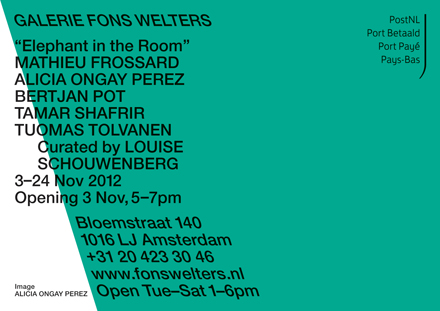
"The Elephant in the Room" is an upcoming exhibition at Galerie Fons Welters in Amsterdam, featuring the work of Alicia Ongay-Perez, Mathieu Frossard, Tuomas Tolvanen, and Bertjan Pot.
Contextualising Inside-Out II, Alicia Ongay-Perez
I added a line of text to the wall to confront both the objects and their surrounding audience:
"The idea of neutrality must be challenged even in objects that seem devoid of an ideology. Has Design become a Narcissus, enraptured with its own image?"
Shortly before Salone del Mobile 2014, I was asked by OKOLO magazine to nominate my favourite ECAL project from the past few years.
Although it was difficult to pick, I ultimately chose the DRM chair, a veteran of Adhocracy that reflects on new conditions of ownership, monitoring, and human-object relationships in the form of a chair that collapses after eight seatings. It was designed by Thibault Brevet with Gianfranco Baechtold, Laurent Beirnaert, Pierre Bouvier, Raphaël Constantin, Lionel Dalmazzini, Edina Desboeufs, Arthur Desmet and Thomas Grogan.
Although it was difficult to pick, I ultimately chose the DRM chair, a veteran of Adhocracy that reflects on new conditions of ownership, monitoring, and human-object relationships in the form of a chair that collapses after eight seatings. It was designed by Thibault Brevet with Gianfranco Baechtold, Laurent Beirnaert, Pierre Bouvier, Raphaël Constantin, Lionel Dalmazzini, Edina Desboeufs, Arthur Desmet and Thomas Grogan.
After returning from Basel and hearing Judith Seng's reflections on her practice, I have written more extensively about ACTING THINGS IV - Material Flow at Domusweb.