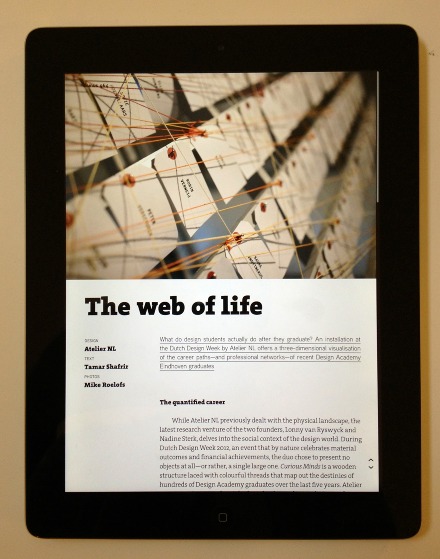

In the common consensus, Limburg is an uncontested territory, a place easily generalized in comparison to its bordering areas: the northern Dutch mentality, the exuberant southern Catholicism, and the post-industrial stagnation of the Ruhrgebiet. In this atlas, we challenge such simplistic perceptions of the region.
The atlas is not only a record of projects that developed on the subject of Limburg in spring 2011, but also constitutes a design work in its own right. The book is organized into different documentary modes: photography, cartography, and a magazine, though the themes in each section overlap. Icons at the page borders function as physical hyperlinks, highlighting certain recurring themes such as society, industry, nature, and so on.
The cartography section is composed of a collection of different maps, each a unique filter on a varied landscape. The maps examine patterns and artifacts of contemporary and historical life, the context of the Euregio Maas-Rijn, and the origins of Design Academy students. Apparently unrelated maps appear side-by-side, forcing readers to draw their own conclusions by comparing information.

The cartography section, together with the photography and magazine parts, brings to light new impressions and interrelationships of Limburg and the greater Euregio.
Click on images to see full-size.


Latent data, processes, and networks are always present, but sometimes they must be consciously defined and visualised to be seen. This project looks at different measures of population at specific geographic points in New York City, including physical people, blog sites (registered to subway stations through an Internet-based social network), and online visitors to those sites.

This data was then mapped out in a three-dimensional matrix of rods, wires, and stretched nylon fabric in an effort to reveal the connections between real and virtual groups of people.
The array of mapped information was superimposed on a representation of the bedrock beneath Manhattan, revealing how geological formations allow people to densify in urban sites and thus generate the critical mass necessary for highly-wired populations.
 |